Performance Standard 
An indicator of a product with a clearly defined measurable parameter.
Analysing and adapting generic and national performance standards and their parameters can be beneficial, delivering standards that are more relevant and specific to the management needs of a local ground, pitch or green. There will be a minimum standard to which a surface should be maintained, and figures quoted will often mean that these are the figures which might be expected as a worst-case scenario at the end of a playing season. In other words, the values for a performance standard should be achieved at all times, not going below the desired values, although in practice there may be a temporary variation due to weather conditions and the immediate aftereffects of play.
In many cases the values given for performance standards can be relatively arbitrary across the five quality grades, but this does allow distinct values to be used when evaluating the overall quality standard to determine if the pitch is performing above, at, or below the required level. For specific sites a manager may therefore determine that a small degree of variation in the values is more appropriate for their pitch where user requirements might differ, or disagree, with those given below. In addition, some soil conditions may also require a slight adjustment to better reflect the specific site conditions, for example, a soil pH might be more alkaline than desired within a guide performance standard, yet the surface is durable and has a good carrying capacity: changing the soil pH may actually reduce the quality and carrying capacity of the pitch.
When evaluating a pitch quality grade, it may be appropriate to have some values as being conditional and influenced by others, rather than absolute when carrying out the evaluation. This would especially apply to soil chemical test values, which might indicate a value which is theoretically below that which is desired from a value given within a performance standard, yet a wide range of key physical values are within or above the desired performance standard.
To reduce the overall grade of a pitch in these circumstances due to a theoretical difference would indicate a lack of experience and insight from the assessor or the assessment process. Flagging the below than ‘ideal’ values for the standard would be appropriate and essential, along with appropriate commentary to accompany the assessment. For example, by emphasising the importance of routine monitoring of the situation and the relationship with other pitch characteristics to observe if any downward trend occurs, in which case additional work, such as additional fertiliser application, may be required to rectify the trend. This approach can reduce the need, or frequency, for unnecessary fertiliser applications or materials used to try and amend soil pH, by only applying if there are early signs, or trends, of specific detrimental issues affecting the wider performance standards for a pitch. This might be a fine balancing act, but one which a competent grounds manager should be well qualified and experienced to undertake as part of their routine management activities.
There is not necessarily a right a wrong precise value for an individual performance standard, but one which is indicative of expectations for a particular quality grade and is also proportional to adjacent quality grades. It is really important to emphasise values as being indicative of a quality grade and must not be taken as being something which cannot be varied: experiences change, knowledge changes, technologies change, and social attitudes change, so informed flexibility is an essential element to managing with performance standards.
At the start of a playing season the actual figures ‘on the ground’ should be as near to optimum or maximum as reasonably practicable and as the season progresses then the pitch will wear, with gradual deterioration occurring. The aim of a ground’s manager, or one of the aims, is to manage the input and usage levels to ensure standards are maintained as best they can, for example to ideally being 100% desirable grass ground cover, but do not drop below or exceed the relevant parameters for the particular standard of pitch.
The values for any standard can be amended to meet the needs of a client or contract, however, having an understanding of the practicalities and consequences of values is important if a pitch is to be managed to performance standards.
Whilst it might appear a good idea to have a perfectly pristine surface, what this would mean in practice is that as soon as there is a slight blemish from a disease or pest, for example, then immediate action would need to be taken to rectify this otherwise that individual performance standard would not be achieved.
If physical and financial resources are not available, then it is unrealistic to plan for very high standards in practice. If it is unlikely these are to be achieved, then there is little point utilising performance standards as a means of measuring the effectiveness of grounds management activities. An honest conversation is needed within clubs as to what is realistic with available or proposed resources, and what is actually acceptable to club members: providing options - especially costed ones - for different levels of quality helps members to better manage expectations.
Values within a performance standard and relevant grades do need to be realistically achievable, on a consistent basis, over time. Having values that are unrealistic to a maintained in natural (albeit human managed) environment which is subject to wear and which are routinely not achieved in practice will devalue the use of performance standards.
It is often forgotten that performance standards for turfgrass surfaces were introduced in the late 1980s to help local authorities specify what was required for consistent desired grounds maintenance outcomes so as to ensure that a cost-effective service was provided by a contractor. This also helped a contractor when pricing a contract, enabling them to more accurately cost objective requirements and thereby reducing and eliminating many of the subjective inferences that related to what was previously meant by a ‘good’, ‘satisfactory’ or similar turf surface. Failure to meet the desired performance standard would result in defaults which would have to be rectified within a defined timescale. Consistency was important because continued failures in outcome would result in an accumulation of defaults, which, if reaching a pre-determined number, could then result in termination of the contract.
Utilising performance standards for non-contract situations will still have an aim of ensuring consistent outcomes are achieved, throughout a playing season and year, by appropriate management of maintenance inputs, but just as importantly in managing the usage that takes place, i.e. user management. Understanding carrying capacity (i.e. sustainable use) is an important aspect of performance standards and their management.
Having match cancellation policies in place is an important part of user management if performance standards are to be appropriately managed through an entire year. However, quite often, the desire to get a game on will over-ride that of what is appropriate for the pitch in being able to ensure the surface is provided to the stated standard throughout the entire season, even allowing for approved deterioration (which will be reflected in the parameters for the performance standards) of the surface as the season progresses. If it has been agreed that a certain grade of pitch is to be provided during certain periods of the year, then failing to achieve the grade indicates that the pitch is not being effectively managed. Clubs will need to reflect on this, as well as funding bodies, to determine what it is they are actually hoping to achieve with their available resources because either performance standards are to be used effectively or not. Pretending to manage a pitch using performance standards is not a sustainable pathway, although it is often portrayed as one.
An illustrated example might help to demonstrate this: during the early to middle of the playing season a pitch has a live ground cover of 85%, two matches are scheduled to be played on the weekend, however, the ground is already very wet, but not quite waterlogged, and more light rain is forecast. A game can be played safely on the pitch, although the playing experience would be no more than satisfactory, and unsatisfactory at times.
The pitch standard which is to be maintained at all times to ensure performance meets expectations of players and the league, is Grade 3 (intermediate). However due to the wet soil conditions, the surface is very soft, will wear and divot rapidly, have poor traction and increased tearing of the sward and will increase surface smearing from wet soil and increase compaction within the soil profile. These are typical outcomes from playing in unsuitable ground conditions, however, the clubs want to get the game as they know it will be safe, but do not understand the concept of managing a pitch to performance standards. The grounds manager understands the consequences of playing on a pitch in this condition and expects that live ground cover will be significantly reduced, especially down the central third of the pitch, with the end result being a live ground cover in the region of 60% to 70% after just these two games: this is well below the minimum 80% live ground cover for a Grade 3 pitch. The two-game take place and the assessed live ground cover is now 68%, dropping 17 percentage points. In a contract situation, the pitch provider would be penalised and would default on service provision for this performance standard, however, for a volunteer club this is not relevant, but what they will have is a knock-on effect of reduced pitch quality and player experiences for a certain minimum period, which will be influenced by prevailing weather conditions, and if this was formally assessed would show that they are not managing the pitch effectively. What may typically happen in practice is that at a few predetermined assessment points, the pitch meets the minimum standard for most of the range of criteria so the overall rating will be within the desired grade. Over the season though there will have been numerous occasions when pitch quality was significantly below the desired minimum for a range of key standards, yet this has been masked by the limited formal assessments carried out. The illusion of managing to performance standards is therefore given, but in practice this is far from what is happening. A more robust from of quality assurance and control needs to be implemented if managing to performance standards is to be undertaken in the way it was originally conceived: to provide a cost-effective service provision, with minimum quality standards achieved on a consistent basis.
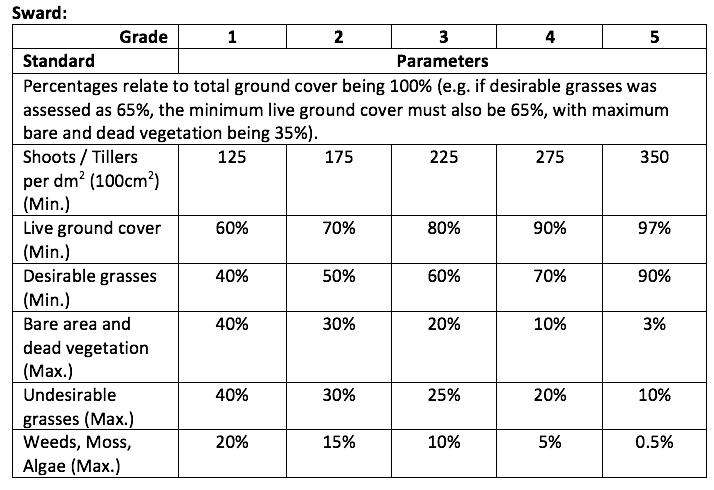
An example of illustrative performance standards for a football pitch across a range of quality levels from Grade 1 (entry); Grade 2 (medium); Grade 3: (intermediate); Grade 4 (high) and Grade 5 (premium) might be as follows:
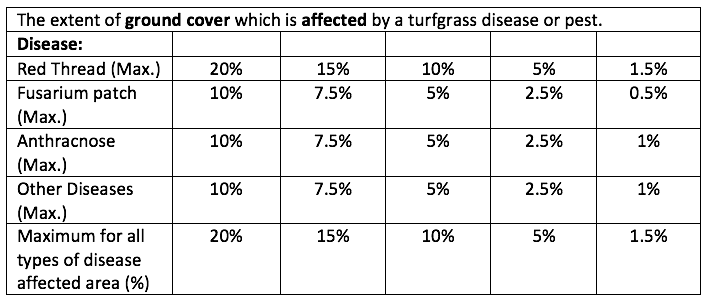
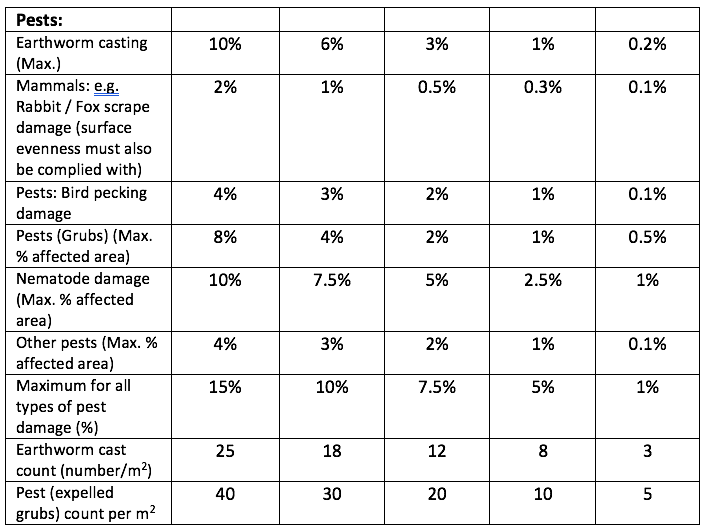
N.B. Actual parameters used within performance standards can vary between different authorities and user requirements, as well as revisions due to continued research, although the following provide a useful starting point as an indicative comparison between different grades. With greater awareness for environmental responsibility and the need to continue to reduce the number of artificial-synthetic products being loaded / sprayed into the environment, especially where sustainability is being promoted, an increased number of performance standards have been included within pests and diseases as the setting of appropriate thresholds for control is an important component of Integrated Pest Management (IPM). Without a more detailed breakdown than exists with most performance standards then this will limit the practical relevance and understanding of IPM. The setting of values for thresholds will be determined by the expected overall quality of a surface and trying to determine the maximum value which might be set for damage that would still not reduce the overall surface and playing quality. For example, if the fusarium threshold is set at 5% for an intermediate quality pitch, would this level fundamentally affect the overall quality and experience of players? If not, then this value could be increased as by doing so this would mean less need for artificial-synthetic pesticides or substances to be applied, as well as potentially reduced physical practices, to help contribute to controlling the disease, which will also reduce the cost of pitch maintenance. If, by contrast, the value was considered too high for expectations then there would be increased likelihood of higher maintenance inputs and costs. The acceptable percentage values may also change during the playing season, with values that relate to a more pristine surface to start the season, but gradually allowing a higher percentage of deterioration, or undesirable elements, towards the end of the season because it would not be long before renovation of a pitch would take place, so why worry too much about a less than pristine surface at this time of the season?
A numeric rating can be applied to each standard and grade which describe the overall quality rating for a product. For example, a basic approach could be to allocate 5 points for grade 5 gradually decreasing to 1 point for grade 1, with no points being awarded for a value outside of the required parameters.
The overall rating could be determined from the sum of each values and could be seen as indicative of the entire surface, although this will depend on the extent of the sampling undertaken and if the sampling locations are generally representative of the surface. A significant limitation of this approach is that some standards are much easier to achieve than others included within an analysis and this can result in an overall high mark that does not represent the actual quality of the pitch itself.
A more realistic, objective and manageable means of providing a representative picture of overall pitch quality could focus on determining the overall quality of a suitable group of related standards and then apply a weighting to the groups to better represent the ease or difficulty of them being corrected on the ground and as a reflection of how much control a grounds manager can have over pitch quality.
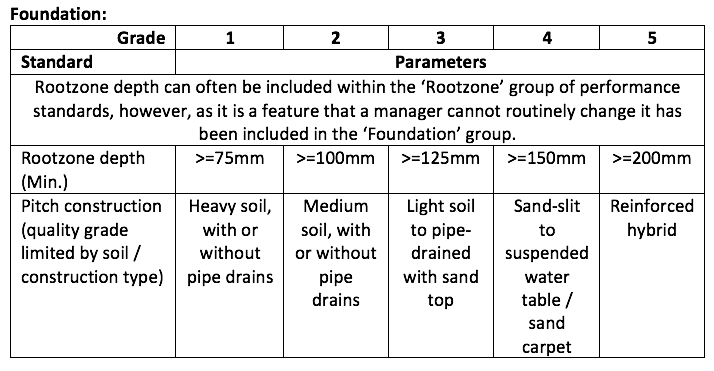
Some features, primarily the pitch construction and the depth of topsoil/rootzone, are two standards over which a manager does not really have any routine control, because there is a significant financial input required to improve these through extensive reconstruction work. Pitch construction has the most significant influence on carrying capacity and also what is realistically achievable from a pitch regards the majority of performance standards.
Whilst aspirations to have an excellent surface on a clay-based soil might be noble this is totally unrealistic and false expectations will be given if thought otherwise. Including pitch construction as a core determinant of pitch quality will provide a realistic ceiling on expectations, as each pitch construction, as well as depth of topsoil/rootzone will be limiting factors on overall pitch quality.
Groupings for quality ratings
The PQS framework (until 2022) had three categories of quality in which performance standards could be grouped as follows: Structural Quality; Presentational Quality and Playing Quality, however, this can be revised and enhanced to other category names to better represent what is being rated.
A. Foundational Quality Rating:
This would consist of the two standards: Pitch construction and Rootzone depth.
1. Pitch construction: This will limit the maximum possible pitch quality and especially the playing experience that can be provided and sustained over a playing season.
Pitch construction can be categorised as follows along with the maximum quality grade that can realistically be achieved over a playing season. The carrying capacity of each pitch category will vary depending on geographic location, local weather conditions, maintenance activities, usage management and the status of the many characteristics (performance standards) of a pitch, however, the maximum quality grade that can sustainably be achieved for the different soil or constructions might be given as follows:
• Heavy soil: Entry Grade 1.
• Medium soil: Medium Grade 2.
• Light soil: Intermediate Grade 3.
• Pipe-drained with sand top: Intermediate Grade 3
• Sand-slit: High Grade 4.
• Suspended Water Table; Sand Carpet: High Grade 4.
• Reinforced-Hybrid pitch with inclusions, stitched grass, or carpet layer: Premium Grade 5.
2. Rootzone depth has a significant influence on sward durability and recoverability. The grass rooting depth is limited to the depth of rootzone, which influences a swards drought resistance, nutrient uptake, divoting potential, disease resistance and recovery, ability to withstand pest damage and recovery, potential for weed colonisation, uniformity of colour, surface hardness and traction, carrying capacity and overall pitch quality.
B. Surface Quality Rating
• Live Ground Cover: A clear visual indication of pitch quality, (influencing a player’s perception of pitch quality) although well maintained surfaces which are managed within the carrying capacity of a pitch will retain good live ground cover over a pitch, providing for an appropriate playing surface and playing experience.
• Dead & Bare Ground Cover: Clearly this should be kept to a minimum, but as the season progresses then it is highly likely that the percentage ground cover for this factor will increase. If ‘Live Ground Cover’ is used in an evaluation then the ‘dead and bare ground cover would not normally be used because they are directly, inversely, related to each other.
• Desirable Grasses: This is related to live ground cover, but excludes the undesirable grasses, as well as weeds, moss and algae which all detract from a good playing surface. Maintaining desirable grass species is a reflection on how well the pitch is managed to help out compete undesirable elements.
• Undesirable grasses: Most likely these would-be annual meadow grass and possibly Yorkshire fog, but undesirable grasses will reduce playing quality and detract from an overall uniform appearance.
• Weeds, Moss & Algae: Keeping these to a minimum through good management practices will encourage a more competitive and resilience grass sward.
• Other:
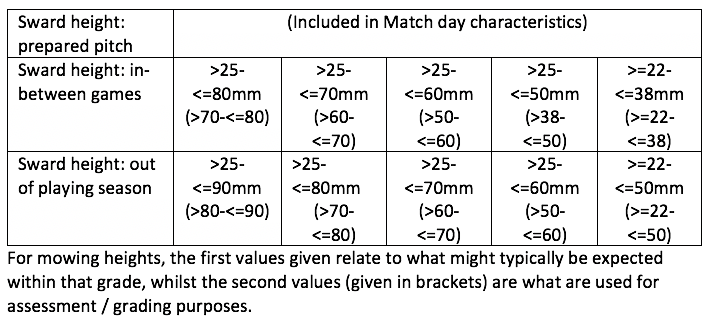
• Sward height (between games): Allowing a sward to recover from match wear will improve its subsequent ability to withstand further wear. If pitches have been cut especially short, then raising the height of cut as much as practicable for the quality of pitch will reduce the stress exerted on a grass plant.
• Sward height (out of season): Encourage maximum root growth and development, whilst providing a suitably dense sward should be the aim of out of season mowing practices. Aim to mow as high as possible and as practicable for the desired pitch quality.
C. Disease Quality Rating
The extent of ground cover (live and dead vegetation) which is affected by a turfgrass disease.
• Anthracnose:
• Microdochium:
• Red Thread:
• Other Disease:
D. Pest Quality Rating
The area of the total ground cover that is also affected by earthworm casts, which cover either live vegetation, dead material, or on bare soil; as well as damage caused by other pests. For example, if 10% of total ground cover is classed as dead / dying, then it might be found that nematodes and grubs are estimated to be affecting 5% points of this figure, whilst if live ground cover is estimated at 90% then pest damage might be affecting 12% points of this figure.
• Bird damage:
• Earthworm Casts: At certain times of the year earthworm casting, where heavy, can have a significant negative impact on pitch quality.
• Grub damage:
• Nematode damage:
• Other pest damage:
E. Rootzone Quality Rating
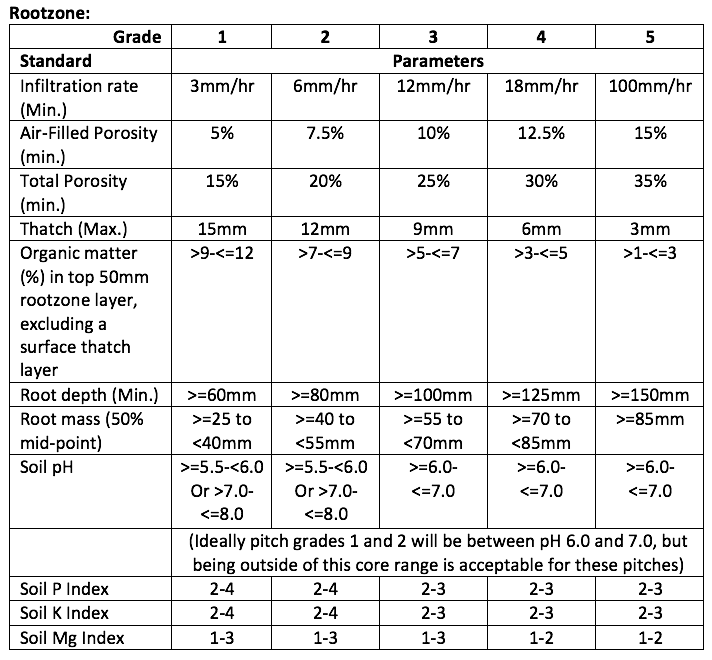
• Infiltration rate: This is usually inferred as drainage rate (which would also include the hydraulic conductivity of the soil) but it is the initial entry of water into the surface which is being looked at here. A grounds manager can have a significant influence (within the infiltration limits of the soil texture) on this factor.
Soil (and pitch drainage) conditions can change quite quickly, especially if maintenance and renovation works are either not carried out or undertaken sub-optimally, especially when soil conditions are unsuitable. Compaction, surface smearing, organic matter builds up and sealing of slit drains will reduce a previously well-drained pitch to one that can rapidly turn into a waterlogged pitch. The soil infiltration rate influences playability, especially if rainfall occurs close to kick off time.
A well maintained and managed pitch will typically have better overall infiltration rates than a pitch that has been poorly maintained or managed. Even an Premium Grade 5 pitch, managed poorly or inadequately resourced will not be able to sustain the top grade for any length of time. Renovation work with various decompaction machinery can readily improve infiltration as well as percolation rates, although the latter are often limited by the construction type and soil type, over which a grounds manager has little control. For the categories of Heavy soil and Medium soil, major (i.e. expensive) reconstruction-drainage works would typically be required if relatively high usage was required.
• Thatch: A small amount of thatch (<5mm) can aid sward resilience, although increasing amounts reduce resilience and increase the likelihood of surface water retention and a reduction in playing quality.
• Organic matter: A small amount of organic matter within a rootzone helps in the retention of nutrients and moisture, however, increasing amounts creates a softer surface with reducing drainage rates, all of which negatively impacts on playability.
• Root depth: A good depth of rootzone (or topsoil) provides for potentially deep root growth and improved sward resilience. Good grounds management will encourage the development of a deep and substantial root system over time. This feature will significantly contribute to a good playing experience, although because roots are hidden from view, this is often an ignored and/or misunderstood factor.
• Root mass: A shallow mass of roots will reduce sward resilience, so the aim is to have significant root mass to a reasonable depth, not just a few roots to a good root depth. Typically, this would be judged by estimating the depth of where 50 percentage of the mass of roots is greater and also less than the given depth (i.e. the mid-point depth for root mass).
• Soil pH: Football pitches will be predominantly Perennial ryegrass swards, so the soil pH should be aimed to best support this grass species. Soil pH of 6.0 - 7.0 will typically provide optimum conditions, whilst pH 5.5 - 6.0 will see the grass struggle somewhat, but will be generally satisfactory for lower quality pitches, especially where usage is low to medium.
• Soil P Index: An Index of 2 or greater would typically indicate no additional phosphorus is required as part of maintenance, although where newly seeded areas are present then a light application may be beneficial. If soil pH is very acidic then a foliar feed may be more beneficial as otherwise the P may become mostly locked up by the soil.
• Soil K Index: An Index of 2 or greater would typically indicate no additional potassium is required as part of maintenance, although where newly seeded areas are present then a light application may be beneficial. If the soil is very sandy then a foliar feed may be more beneficial to reduce the potential for leaching.
• Soil Mg Index: An Index of 1 or 2 can typically indicate no additional magnesium is required as part of maintenance. If soil is very sandy then a foliar feed may be more beneficial to reduce the potential for leaching.
F. Match Day Quality Rating
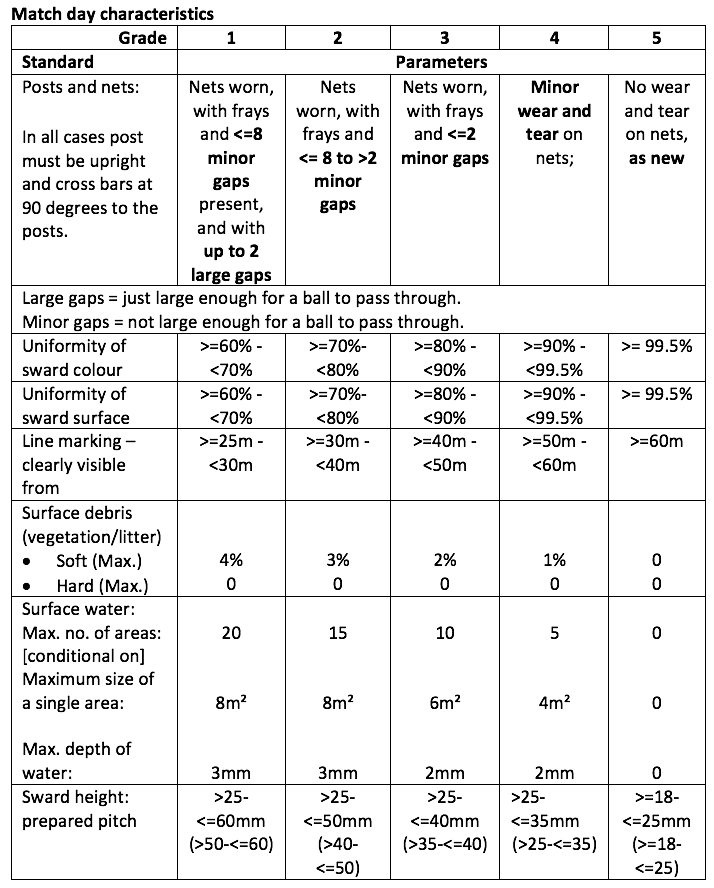
• Line Marking: A pitch needs to be marked out in accordance with the Laws of the game, and that the lines are adequately visible from a certain distance.
• Posts & Nets: Prior to a game it is essential that posts and nets are checked to ensure they are undamaged, properly secured, and without any sharp projections present.
Goal posts must always comply with required standards of being upright and with the crossbar at right angles to the uprights.
Ideally nets will be entire and relatively unworn, however, a small amount of wear will often be present on nets. Some degree of wear and tear and in some cases minor or larger gaps can be generally acceptable for a game depending on the standard of play expected.
• Surface debris: No surface debris should be present on a pitch, although a small amount of soft litter, such as leaves, or paper litter might be present on lower standard pitches and be acceptable for those situations.
• Surface Water: The presence of surface water typically indicates poor infiltration and percolation rates, often resulting from compaction, thatch, surface smearing, as well as poor soil structure and a soil texture with poor proportions of sand.
Ideally there will be no surface water for a match, however, a small amount will often be present during winter months for some pitches. So long as it is safe to play on and the water is not excessive or deep, then a generally satisfactory game can usually be played, however, this will need to be balanced against the amount of damage that could be caused to the pitch.
A range of values can be recorded to better reflect the decision making that occurs in practice, rather than just saying that some water presence means automatic cancellation of a match. Four variables are used, and if any of them is exceeded for that quality grade, this would mean that it does not comply with it.
• Sward height (Prepared pitch): Whilst this is easy to achieve, having a sward which is either too short or too long will result in a poor game.
• Uniformity of colour: A pitch that has a uniform colour is desirable. A pitch with patches of different colour will be visually unattractive, although have practically zero impact on playability. The actual shade of green for the grass sward will vary depending on the time of year and with the use of stripes on a pitch this would mean that the uniformity relates to each shade of stripe.
• Uniformity of sward: This is the smoothness of finish, with a cleanly cut grass so is a direct measure of effective mowing practices, in particular how well the mower has been set and sharpness of blades.
G. Playing Quality Rating
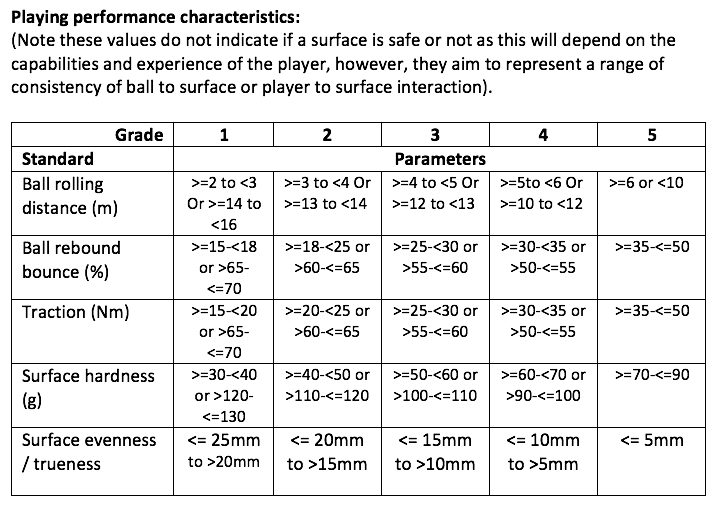
• Ball bounce: A uniform bounce is required to improve playing experience; too hard a surface will have a high bounce, whilst too soft a surface will create a 'dead ball'.
• Ball rolling distance: This is related to surface evenness and ground cover, to produce a consistent length of roll / skim across the surface for a ball.
• Pitch hardness: The majority of players would most likely desire a consistent firmness of pitch.
• Pitch traction: To enable a player to turn and control the ball adequate traction, as a minimum, is needed.
• Surface evenness: A smooth even surface allows for a smooth roll and skim of the ball, without bobbling nor unforeseen changing of direction. A surface with large depressions and holes is hazard and should not be played on until these have been filled in and corrected.
Other terms
Other terms may also be considered, such as Technical Quality (mainly the former structural elements, but this could be sub-divided into 2 parts, with the scientific laboratory assessed features beings separate from physical pitch measurements using corers and quadrats for example), Perceptual Quality (mainly the presentation and playing elements), Customer Quality (some structural elements, e.g. sward height and live ground cover / bare area) along with mainly presentation and playing elements, as these are the features or parameters a customer is primarily interested in, not the mainly technical aspects), Match Day Quality (focusing just on the key match day requirements), and Playing Experience.
The purpose of using certain named categories or groupings would be to better engage users, especially with those features that relate to customer satisfaction (arguably one of the main outcomes of success), whilst grounds managers would apply their skill and knowledge to the technical aspects to ensure customer satisfaction is achieved on a continuous, or almost continuous, basis, as well as providing a basis for ensuring pitch management is on a sustainable pathway.