Football Pitch Maintenance: 47. Recovery from Drought 
When rain does restart and the drought breaks, assess the pitch condition to see if any areas are especially thin with poor grass coverage. These will need to be renovated to bring the pitch back up to the desirable standard. Once rain has started again and is forecast to be more regular, rather than just the odd scattered shower, and when temperatures are cooler and more suitable for grass growth, then surface recovery can be started.
Early signs of recovery will be green shoots appearing where previously the grass was just a straw brown colour.
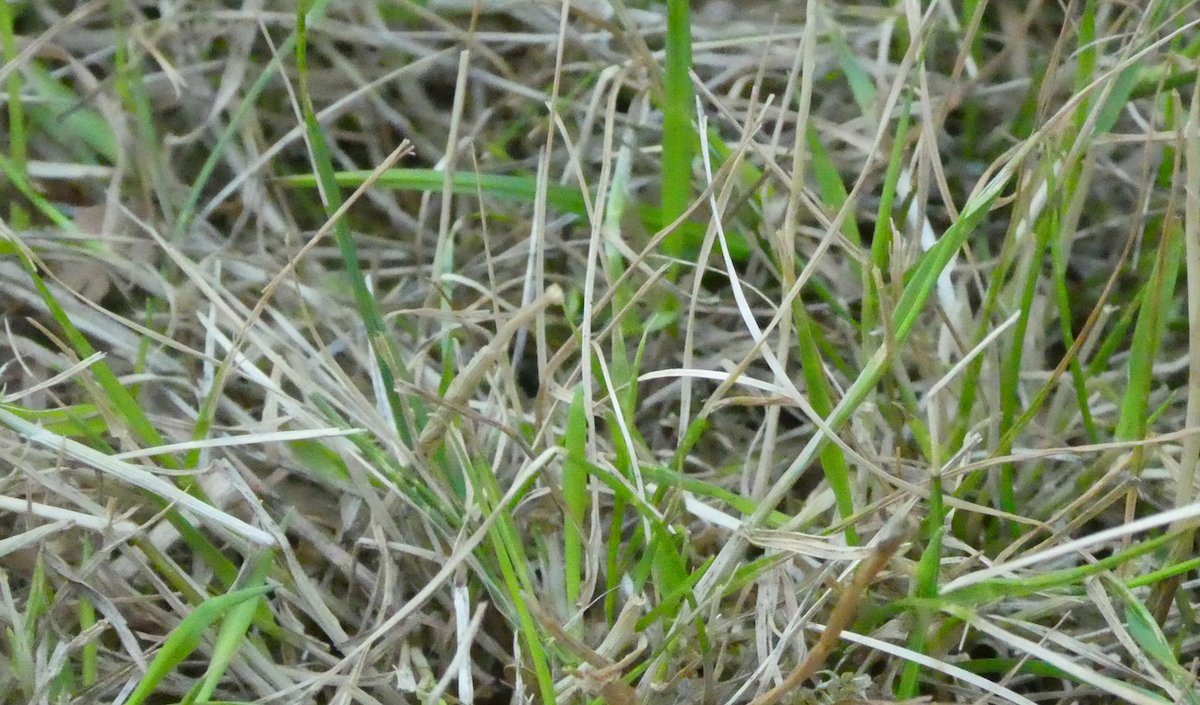
Green shoots of recovery following a prolonged drought
Rainfall will gradually start to penetrate into the hard soil surface. Supplementing rainfall with irrigation water might be considered if watering bans are not in place and also where there are adequate means of applying water in sufficient quantities. Once the surface layer has softened slightly then shallow tining or sarel spiking, can begin. This will help water to penetrate further into the soil profile, reducing its hardness and thereby allowing slightly deeper aeration to then take place.
Be careful not to try and aerate too deeply too quickly with too deep a setting because lower down the soil profile might still be hard and impenetrable. Trying to punch into a hard layer can damage the aeration equipment, resulting in costly repairs, as well as causing surface disruption and unevenness.
In the first instance carry out a very light surface cleansing using a scarifier or metal tined rake. Don’t forget that the grass is only starting to come out of a very stressful period and should be treated with great care. Only once the grass is growing quite actively again should scarification into the surface layer or soil profile be considered.
This light surface cleansing will help raise the grass upright, clear out dead and decaying organic matter that is on the pitch surface and will act as a sort of rejuvenator to help reinvigorate growth. Once the grass is in a more upright situation then more routine drag brushing can also be considered to help maintain it in that condition.
A low nutrient, especially nitrogen, content liquid fertiliser or biostimulant, can help in the initial recovery stage and initiate regrowth. Be careful not to apply a granular fertiliser too soon after a drought because soil moisture will most likely still be inadequate to help dissolve the fertiliser to make the nutrients available to the grass plant. Realistically, it might be early to mid-September before soil moisture conditions are suitable for the application of a granular autumn-winter fertiliser to be applied. This shouldn’t be a particular problem if a liquid fertiliser or biostimulant with low nutrient content had been applied earlier following the break of the drought.
Applying a wetting can help to improve the ability of water to penetrate the soil profile, although determine if this is a cost-effective activity in conjunction with other mechanical work that is being carried out for pitch recovery. Whilst it will often to beneficial to apply a wetting agent, it might not be an essential or cost-effective activity for the quality of pitch being produced.
Overseeding of thin and bare areas, following any mechanical work that might be needed to help prepare the pitch areas, may also be required. Apply a light top-dressing to protect the seed and where levels are uneven then apply additional top-dressing to improve surface levels. If seed is sown on a pitch, then it is essential that either adequate rainfall is forthcoming or there is a suitable means of applying irrigation water to aid germination and initial seedling establishment.
Mow the pitch on a suitable basis so as to ensure that no more than one-third of the grass height is removed at any one time. This will help pitch recovery by ensuring that less stress is placed on the grass and that less impact is made on the root system when compared with much more than this amount being removed in each cut. Keep the height of cut as high as practicable to encourage improved root development.
Once the soil profile has become adequately moist, which might not be until September time, then a decompaction of the pitch might be considered. The aim of this activity will be to take advantage of a soil that is neither too dry nor too wet so as to get optimum soil shattering and fissuring, to reduce soil density and increase soil pore space, whilst also minimising any soil smearing. This will improve rooting potential and allow for more rapid surface to sub-surface water removal once autumn rains start to become more regular.
Be careful not to plan too many games on pitches during the initial drought recovery stage otherwise excessive damage may be caused which negatively impacts on pitch playing performance and quality from autumn onwards when subsequent growth is limited and weak. Do keep assessing the pitch condition during this time and see how well it is coping with the more limited use before gradually increasing the number of games that are played up to no kore than the carrying capacity for the pitch at different times of the year.
Be careful not to try and aerate too deeply too quickly with too deep a setting because lower down the soil profile might still be hard and impenetrable. Trying to punch into a hard layer can damage the aeration equipment, resulting in costly repairs, as well as causing surface disruption and unevenness.
In the first instance carry out a very light surface cleansing using a scarifier or metal tined rake. Don’t forget that the grass is only starting to come out of a very stressful period and should be treated with great care. Only once the grass is growing quite actively again should scarification into the surface layer or soil profile be considered.
This light surface cleansing will help raise the grass upright, clear out dead and decaying organic matter that is on the pitch surface and will act as a sort of rejuvenator to help reinvigorate growth. Once the grass is in a more upright situation then more routine drag brushing can also be considered to help maintain it in that condition.
A low nutrient, especially nitrogen, content liquid fertiliser or biostimulant, can help in the initial recovery stage and initiate regrowth. Be careful not to apply a granular fertiliser too soon after a drought because soil moisture will most likely still be inadequate to help dissolve the fertiliser to make the nutrients available to the grass plant. Realistically, it might be early to mid-September before soil moisture conditions are suitable for the application of a granular autumn-winter fertiliser to be applied. This shouldn’t be a particular problem if a liquid fertiliser or biostimulant with low nutrient content had been applied earlier following the break of the drought.
Applying a wetting can help to improve the ability of water to penetrate the soil profile, although determine if this is a cost-effective activity in conjunction with other mechanical work that is being carried out for pitch recovery. Whilst it will often to beneficial to apply a wetting agent, it might not be an essential or cost-effective activity for the quality of pitch being produced.
Overseeding of thin and bare areas, following any mechanical work that might be needed to help prepare the pitch areas, may also be required. Apply a light top-dressing to protect the seed and where levels are uneven then apply additional top-dressing to improve surface levels. If seed is sown on a pitch, then it is essential that either adequate rainfall is forthcoming or there is a suitable means of applying irrigation water to aid germination and initial seedling establishment.
Mow the pitch on a suitable basis so as to ensure that no more than one-third of the grass height is removed at any one time. This will help pitch recovery by ensuring that less stress is placed on the grass and that less impact is made on the root system when compared with much more than this amount being removed in each cut. Keep the height of cut as high as practicable to encourage improved root development.
Once the soil profile has become adequately moist, which might not be until September time, then a decompaction of the pitch might be considered. The aim of this activity will be to take advantage of a soil that is neither too dry nor too wet so as to get optimum soil shattering and fissuring, to reduce soil density and increase soil pore space, whilst also minimising any soil smearing. This will improve rooting potential and allow for more rapid surface to sub-surface water removal once autumn rains start to become more regular.
Be careful not to plan too many games on pitches during the initial drought recovery stage otherwise excessive damage may be caused which negatively impacts on pitch playing performance and quality from autumn onwards when subsequent growth is limited and weak. Do keep assessing the pitch condition during this time and see how well it is coping with the more limited use before gradually increasing the number of games that are played up to no kore than the carrying capacity for the pitch at different times of the year.