Module 6:

Turf science

6.1 Turfgrasses

1   Grass identification features

The main characteristics and terms that can be used to identify a grass species include the following:
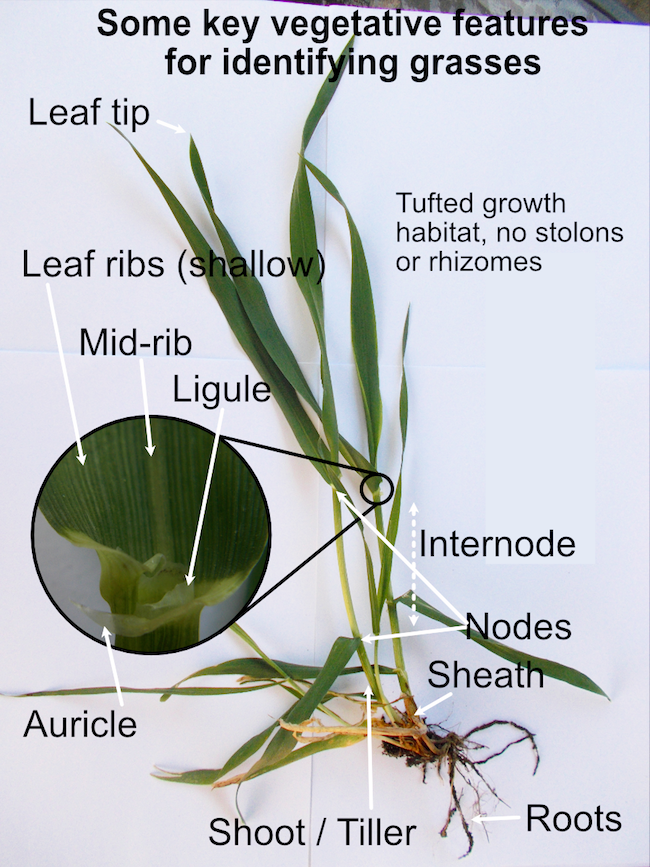
Grass identification features

2   Descriptions of grass identification features

  • Auricle: A small, often curving, outgrowth that sometimes appears at the base of a leaf blade of some grasses. Most grasses don’t have an auricle.
  • Ligule: Either small whitish to translucent membrane at the base of the leaf blade where it joins the sheath. A few grasses have a ligule that is just a small fringe of fine hairs.
  • Shoot: A grass stem along with its leaves. There might typically be from 2 to 4 active leaves per shoot.
  • Tiller: Another name for a plant shoot.
  • Leaf type: This might be bristle-like and often rolled inwards (like red fescues) or flat and also folded along the mid-rib (like perennial ryegrass or annual meadow grass).
  • Node: A point on the stem where a leave arises.
  • Internode: Part of the stem between two nodes.
  • Sheath: A covering of the shoot at the lower part of a leaf or shoot. This can often be peeled back to expose a coloured basal shoot.
  • Lower shoot colour: Some grasses have slightly coloured lower, basal, parts of shoots. This isn’t a wholly reliable diagnostic feature but helps as just one part of many possible features.
  • Mid-rib: The main central vein on a leaf.
  • Leaf tip: The end of a leaf blade, sometimes pointed, appearing like a boat, or slightly rounded / blunt.
  • Tramlines: A few grasses have two parallel translucent lines sitting astride the mid-rib.
  • Leaf ribs: Some leaf blades are smooth, whilst others might have shallow (also called weak) or prominent ribs visible on the leaf.
  • Hairs on leaf or sheath: Some leaves and sheaths are smooth, whilst others might be hairy with a light to heavier coverage of usually fine and small hairs.
  • Young leaf in shoot: If the shoot is cut horizontally below the base of a leaf the cross section will typically show a young leaf as being folded along the mid-rib or rolled like a spiral, appearing like a cylinder.
  • Vegetative growth: A grass plant might grow in a clump (called tufted), spread sideways by shoots above the ground (called stolons) or spread sideways by shoots that grow underground (called rhizomes).
  • Inflorescence: The flower head at the end of a grass stem. These aren’t often seen on turfgrasses due to regular mowing, although annual meadow grass is the most common grass which can regularly set seed below many mowing heights. The three different types of grass inflorescence are called panicle (annual meadow grass), raceme, and spike (perennial ryegrass).

We will now carry out a visual comparison between the two commonest turfgrasses found on a football pitch: Perennial ryegrass and Annual meadow grass.

Module progress: 10%