Module 6:

Turf science

6.1 Turfgrasses

1   Annual meadow grass

This is the main undesirable grass that is commonly found in football pitches. The grass is illustrated below, showing some significant identifying features. When a pitch assessment is carried out make sure you can correctly identify this grass because it will help to indicate how successful, or not, the maintenance and management of the pitch has been in keeping this grass at bay.
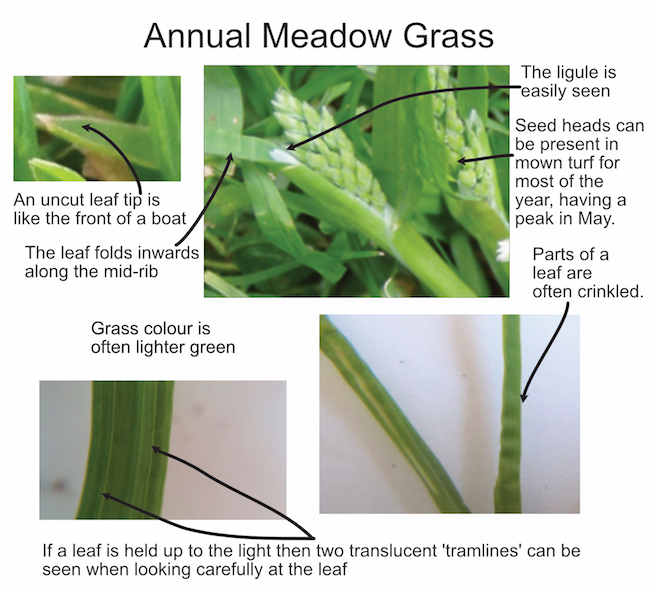
Annual meadow grass

2   The key identifying features for this grass in a sward are typically as follows:

  • Where the grass hasn’t been cut, or it has had a few days growth between cuts, then the tip of the blade will often appear like one end of a small boat.
  • The leaf is typically a lighter green than perennial ryegrass, especially where moisture has been in limited supply during warm weather.
  • If a leaf is held up to the sky then two fine white / translucent lines can often be seen, one each side of the mid-rib. These are often referred to as tramlines.
  • The mid-rib is less prominent than on perennial ryegrass but can still be seen.
  • The ligule is usually quite prominent, being about 2 to 3mm in size.
  • The are no auricles on this grass.
  • Some of the leaves can often appear crinkled, having a slight ripple effect part way up the leaf.
  • The basal sheath is typically a white to off yellow colour, not reddish or purple like perennial ryegrass.
  • A seed head is frequently seen throughout the year, even in shortly mown turf.

We have already covered a lot, even for a brief introduction to turfgrasses, so we'll now have a short recall session to help judge the learning that has taken place for this part of the module.

Module progress: 14%