Module 6:

Turf science

6.2 Turf problems and controls

1   6.2.3 Diseases

For most football pitches that are located in more exposed situations and are less intensively maintained than professional football pitches, the amount of stress imposed on the turfgrass plant is significantly reduced. Reduced grass stress also reduces the likelihood of a disease attack.

Ensuring that a pitch is well aerated, does not retain surface water, is cut at a suitable height, (especially outside of a prepared pitch height which might typically be 25mm), has moderate fertility, and is well groomed will significantly reduce the likelihood of any disease having a major impact on the sward.

The three main diseases for many amateur clubs and lower league semi-professional clubs might be given as Red thread, Leaf spot, and Anthracnose.
2 Red thread:

In many cases this will be a mildly cosmetic attack and will soon grow out, so the need for chemical control will not generally be justified for most soil-based pitch qualities.

The appearance of the sward will be reduced for a short period of time, but simple controls such as a light fertiliser, especially nitrogen, application (depending on the time of year), raising of height of cut (along with boxing of clippings) and improved surface aeration can all contribute to helping overcome an attack of this disease.

Perennial ryegrass can be particularly affected, although this is usually where the pitch is intensively maintained to a very high standard. Annual meadow might also be affected, however, as this grass is undesirable it could be utilised as a way to help remove the grass and for overseeding of a more desirable grass to be undertaken.

The disease can be fairly active where conditions are mild to warm, nutrient levels are low - especially nitrogen and where rainfall or applied irrigation has leached through nutrients, so this could be particularly problematic in sandy soils. Contributing to the extent of this disease will be the usual negative impact of intensity of maintenance activities putting the grass plant under undue stress making it more susceptible to disease attack.

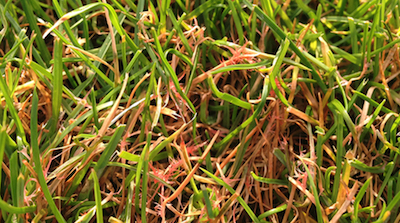
Red thread

Image of red thread disease

3   Leaf Spot

This can be fairly common but is more of a cosmetic disease but can occasionally cause serious damage during warm humid periods, especially to turf which is intensively maintained and within an enclosed environment with minimal airflow.

Reducing or controlling this disease will typically involve keeping the surface dry, removing dew as early as possible, keeping the surface layer well aerated, minimal thatch content, ensuring height of cut is on the higher side, clippings are boxed off and fertility levels provide for a steady healthy growth, neither deficient nor lush growth. In practice, the main grass on a football pitch that is affected by this disease is perennial ryegrass.

4   Anthracnose

This can be a common disease of pitches that contain annual meadow grass. The main contributory factors for this disease in attacking grasses are pitches that are intensively maintained, are compacted, have a wet surface and rootzone, are drought stressed, and/or are low in nitrogen (so a moderate nitrogen fertiliser application can help, depending on the time of year).

It is important to provide good rootzone growing conditions throughout the year to reduce the likelihood of this disease. Chemical control can be applied where it is assessed as being required.

There are two main types of anthracnose: basal rot, which is primarily linked with annual meadow grass and mainly occurs in cooler, wetter periods over the autumn and winter; and foliar blight, which occurs in warmer, drier conditions during the summer period, with it mainly affecting annual meadow grass in football pitch turf, but also perennial ryegrass in intensively maintained situations.

The next two diseases shouldn’t really a big problem for many pitches, especially mid to low quality grades, but where action does need to be taken then cultural and physical means of control should be adequate, unless very severe attacks occur then chemical control may be needed.

5   Microdochium patch (also known as Fusarium patch)

This disease can especially arise on pitches that have poor air circulation and is enclosed by trees, buildings or stadia.

Where a pitch is intensively maintained, and especially where the height of cut is low, being consistently below 25mm, then this disease can be severe and is quick acting once environmental conditions are right for it, these being warm and humid.

Annual meadow grass is especially susceptible to this disease, whilst perennial ryegrass can be attacked, although primarily where it is intensively maintained and routinely under stressful conditions.

6   Fairy rings

Type 1 is the most destructive but would be it would be very rare to encounter these, so basically this can be discounted.

The other Types (called 2 and 3) essentially have a cosmetic effect on the sward. Type 2 can be readily masked by a light application of nitrogen or iron because this one produces a darker green perimeter to a ring, which is something that does not occur with Type 3. In addition, it is possible to remove by hand or chop up by mowing the mushrooms that can appear for both Types 2 and 3. There will not usually be masses of these mushrooms and they will often just be causing a minor nuisance and should rarely be of much concern. Fairy rings can affect any type of turf.

There are many other turfgrass diseases, but in practice they would be of more interest to higher specification and premium quality pitches.

Module progress: 41%