Module 6:

Turf science

6.2 Turf problems and controls

1   IPM / ITM in practice

Prevention of the problem is the first consideration, with the flow of controls for weeds, pest, or diseases (or disorders) being from least toxic to most toxic.

There are essentially four general groups of control that can be used in turf management as part of an IPM/ITM strategy.

Can you name these four general control groups, and can you put them in the order that they would be addressed as part of this strategy? You might have seen a typical IPM triangle that is divided into 4 parts, each part representing one of the control groups.
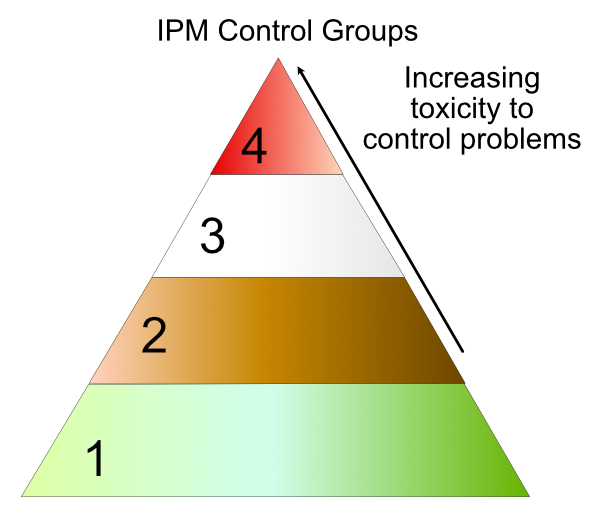
example of IPM control group triangle

2   Solution

Before revealing the solution make sure that you have thought about the question we have just asked.

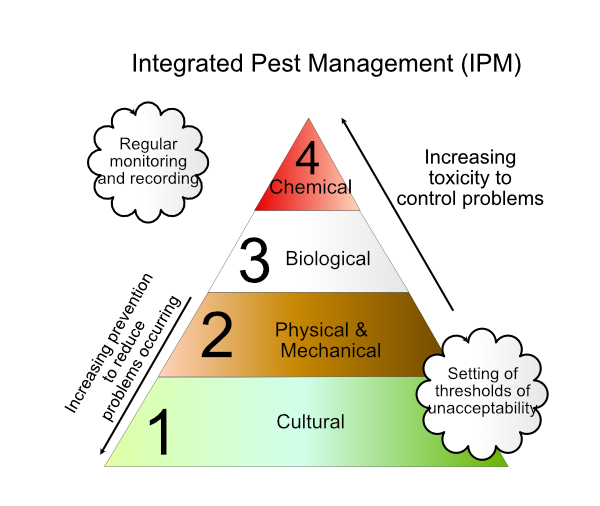
The completed triangle for the IPM / ITM approach is often illustrated similar to this one (although there are numerous variations of the triangle).

example of IPM control group triangle

The control groups proceed in the order of:

  1. Firstly, cultural practices (these are practices, including determining the most appropriate. types of materials to use. This will focus on improving or maintaining turf health and having a good knowledge and understanding of turfculture will help in achieving good outcomes for this control group).
  2. Secondly, physical and mechanical practices. Sometimes these practices are separated into two groups or sub-groups, with physical controls being manual activities without the use of machinery, whilst mechanical controls are those which utilise machinery. Being a skilled operator of machinery or good user of hand tools will improve the effectiveness and efficiency of this control group.
  3. Thirdly, biological controls.
  4. and finally, the fourth group being chemical controls.
Module progress: 51%