Module 6:

Turf science

6.2 Turf problems and controls

1   6.2.6 Systematic turf management

Introduction

Taking a systematic approach to managing a pitch, from understanding cost implications of activities, managing usage of a pitch (which means balancing usage, and utilising match cancellation policies, with achievement of consistent levels of quality), increased engagement with users to appreciate and contribute to producing a sustainable surface, identifying the many benefits and limitations of activities, to the interconnectedness of maintenance practices and the impact and influence they have on the entire grass plant, from roots to shoots. All of this, and more, can further develop IPM and ITM into an integral part of a sustainability framework for turf management.

Sometimes the term holistic management is also used. Whilst this might seem a ‘new-age’ term, it is just another word for a systematic approach.
Example to illustrates the systematic approach: Mowing

The most frequent activity on turf is that of mowing the grass and this also has the most influence on the health and resilience of the turf. The above ground shoot / leaf growth takes priority over root growth for food reserves.

Having low heights of cut increases plant stress requiring an increased reallocation of food resources, i.e. carbohydrates, which are the building blocks for growth and development. The diverting away of resources from root development thereby gradually weakens the root system over time. The consequences of this are a turf with reduced traction, increasing slipping by players, shallower roots which kick out more easily, increased divot repair, a need for increased frequency of irrigation and nutrition (due to less exploration potential for nutrients and water), reduced competition against encroaching weeds and weed grasses, and less resistance to disease and pest damage.

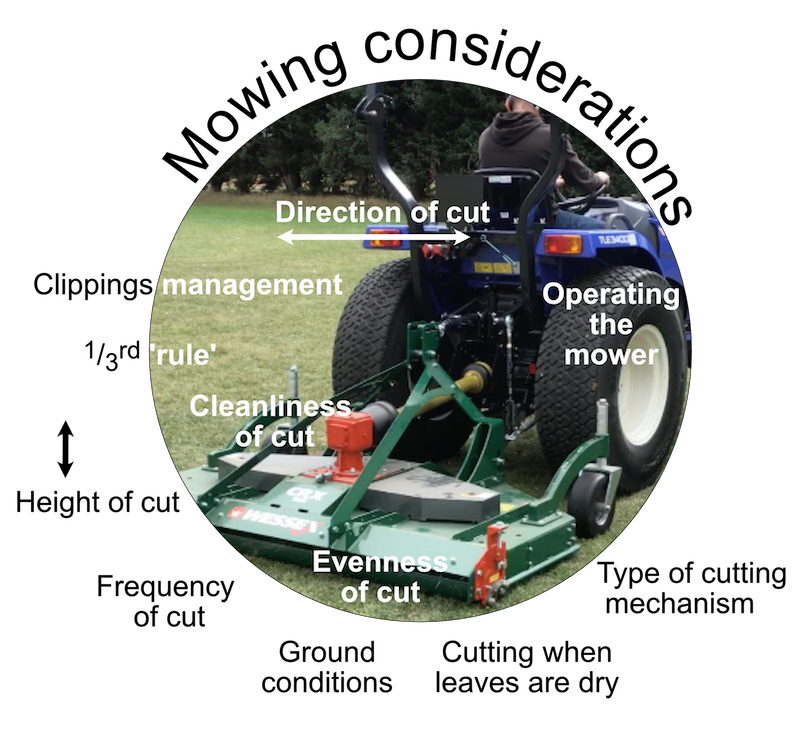
Mowing considerations

2   Mowing practices therefore need to be given a lot more detailed and considered thought before being carried out, and also adapted to prevailing weather and ground conditions.

Key considerations include:

  • Height of cut: Often this is too short for a sustainable situation but is often influenced by the demands of players and managers. Cutting low has a significant negative influence on rooting which is arguably the most important grass feature over the winter period, but the damage done during the main mowing period is unseen at the time. Having a higher, but still acceptable height, increases root growth and distribution, which increases recovery potential and the turfs ability to withstand and then recover from pest attack. The likelihood of disease attack of any substance is also significantly reduced. So, for most pitches and standards of play, having a prepared pitch height of 35mm, instead of a typical 25mm, will significantly improve the sustainability of a grass sward. The difference in height will be significant for the health and development of the grass plant, but essentially insignificant for most player performance (excluding elite and other professional players).
  • Frequency of cut: Typically, this will be too often, which will be stressing the grass that will also increase the time when a cut leaf is exposed to potential disease infection, or not often enough, which will often result in too much leaf being removed per cut, leading to a thinning and weakening of a sward.
  • One-third rule: This is more of a useful guide than strict rule but aim to remove no more than one-third of the height of a grass during any mowing session. This will reduce the likelihood of stressing the grass plant and weakening it, making it less susceptible to disease attack, sward thinning, weed encroachment, and also contributes to better root management.
  • Cleanliness of cut: To ensure the cutting blades are sharp, undamaged and adjusted correctly.
  • Evenness of cut: To ensure the cutting blades are at a uniform height across their entire length.
  • Direction of cut: To vary the direction a pitch is mown to produce a more upright turf and reduce the likelihood of a nap developing.
  • Clippings management: To box off or return clippings depending upon quality desired, available resources and weather conditions.
  • Cutting when leaves are dry: Ideally mowing will take place when the grass leaves are dry as this produces a cleaner cut. If dew is present, then this should be removed and leaves ideally allowed to air dry prior to mowing.
  • Ground conditions: Where the ground is wet then mowing should not take place to reduce the effects of smearing and compaction. Mowing in wetter conditions can also result in noticeable tracks from tyres (assuming these are present on a power unit) squashing more into the turf surface due to it being softer.
  • Mower operation: Turning a mower at the end of each run should be done carefully, with an adequate turning diameter, to avoid bruising or tearing the grass. Operating at a suitable controlled speed to allow for improved cutting, including straighter lines, if stripes or bands used.

Summary

By focusing on correct mowing practices this will allow for optimum outcomes from the activity, which will reduce not only the likelihood of weed, pest and disease problems, but also supports carrying capacity requirements and provides a more positive contribution to overall pitch quality.

Other influences on mowing practice include the prevailing growing conditions (temperature, moisture and light levels in particular), soil nutrient status, including how recent a fertiliser might have been applied as well as the release pattern of the fertiliser and soil pH as this also affects availability of nutrients for plant growth.

What this example mowing illustrates is that there are many interconnected features which influence the sustainability of a pitch.

Sound principles can also be applied to all other maintenance activities, so reviewing course material in other modules will help a groundskeeper and grounds manager to better understand the principles involved in good turf management.

To finish this section, we have a short recall 6-question quiz of IPM / ITM and Systemic turf management.

Module progress: 55%