6.3 Soil science
6.3.5 What is Cation Exchange Capacity (CEC)?
1
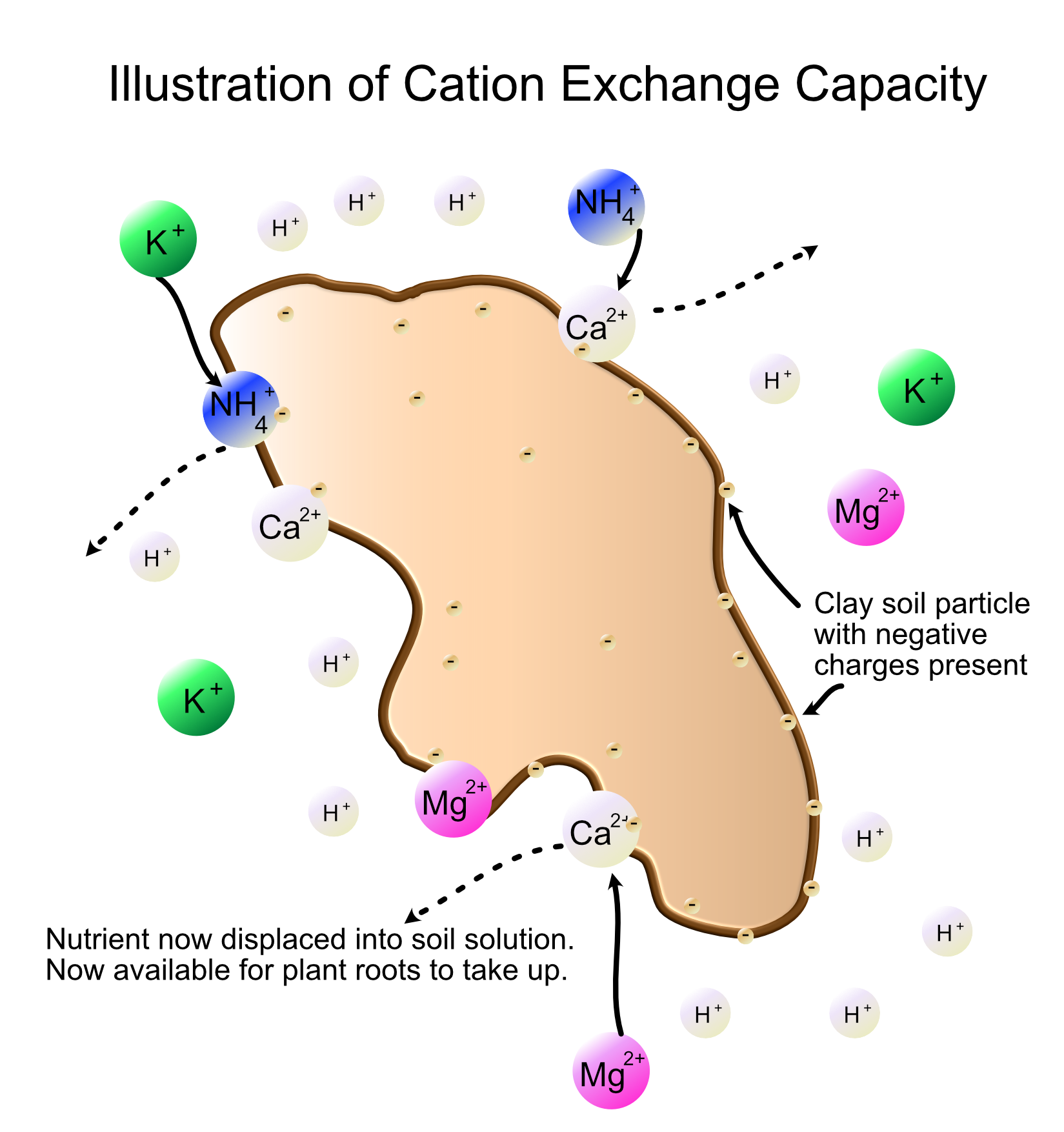
This is basically an expression of the nutrient storage capacity within a soil and the ability of a soil to displace (exchange) nutrients with other nutrients that are ‘floating’ in the soil solution. The higher the CEC the more fertile the soil.
Clay soil particles and organic matter increase the soil CEC, whilst sandy soils will have low CEC as they are unable to retain nutrients very well, with them being more readily washed out of the soil.
If the soil material is thought of as a collection of very small magnets that attract soil nutrients, then the more clay and organic matter within a soil then this would have a lot of strong magnets, being able to attract and store a lot of nutrients. A sandy soil would have fewer and weaker magnets that do not attract and store many nutrients.
It is the positively charged nutrients, especially potassium, calcium, ammonium, magnesium and hydrogen, which are attracted to the mostly negatively charged surfaces of clay and organic matter. Those nutrients that are already attached to the clay or organic material can be exchanged with other nutrients from the soil solution.
A soil that is very acidic (which means it will have higher numbers of hydrogen ions in solution) will often displace a lot more of the positively charged nutrients, thereby reducing the soils CEC. Once elements have been displaced from clay or organic matter sites then those nutrients could be taken up by plant roots because they are now within the soil solution. In addition, once in a soil solution the nutrients can also be washed out through the soil profile, especially where the soil is very sandy, because they are no longer attached to a more stable feature.