Module 8:

Planning the work

8.4 Creating an annual maintenance schedule

8.4.4 Annual mowing regime

1   For a particular pitch the general guide figures might be as follows (although bear in mind that these are only indicative, but helpful to illustrate how to create an appropriate mowing schedule):
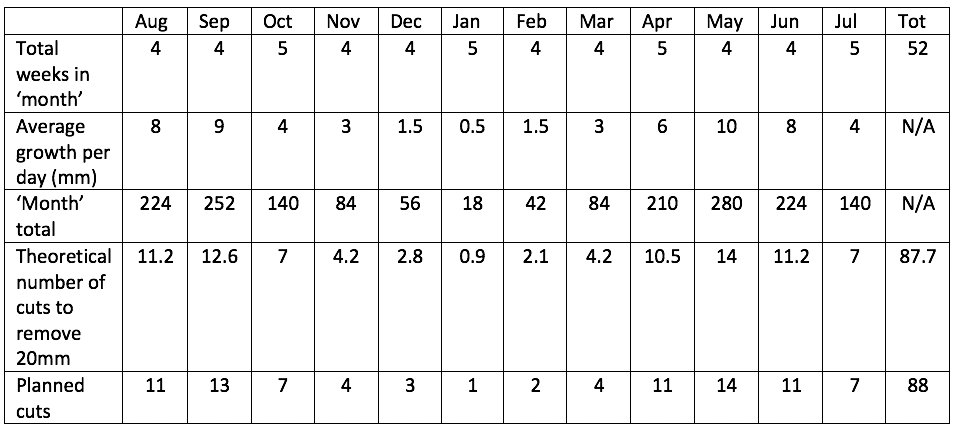
Annual mowing regime for a Grade 3 quality pitch

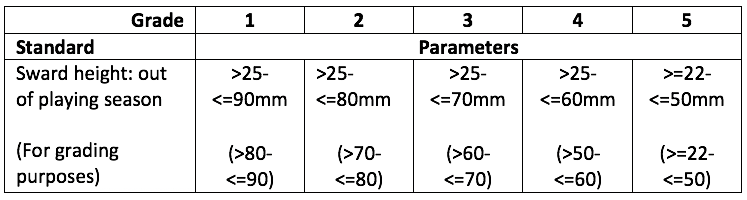
2   Note: May, June and July are outside of the playing season, for this example anyhow. The values for this period are given in the table below. For this example and to reduce possible confusion over calculations we will continue to use the in-between game values.

Mowing heights for out of the playing season

For match day cuts the height of cut setting might typically be from 25mm to 40mm but let us say it is going to be 30-35mm for this particular pitch. Overall, there will be little practical difference to the total annual planned number of cuts. We just want to reinforce the message that these are just indicative and theoretical figures. Monitoring grass growth height is an important yet often neglected aspect of effective pitch and performance management. We will use the number of cuts identified in the table above in the annual maintenance schedule which we will be shortly exploring.

3     Answer the following questions in relation to your own pitch:

  1.   1. How many times do you think your pitch is typically mown over a full year?
  2.   2. Do you think this is about the right number if the desired quality standard of your pitch is to be consistently maintained throughout the year? Yes | No.
  3.   3. If you answered ‘No’ to question 2, how many fewer (or alternatively more) cuts were there than you think was probably required?

4  

We can start to understand why many groundskeepers, especially volunteers, use the grading heights as a general guide only and actually measure the height of the grass after it has been cut and record this as the height for their pitch, so therefore it is practically always within (or above) the desired standard.

We have mentioned before in Section 2.2.2 of Module 2 (lots of 2s there!) that this is not the correct or best way of managing grass height for performance standards and it doesn’t get the most out of the pitch regards playing performance and carrying capacity.

Anyhow, we think that all these figures may have given you a bit of a headache regards the maths involved, so we can safely wrap this up for now.

Hopefully though it has provided some insight into a technical aspect of how a maintenance schedule can start to be built up.

Module progress: 55%