Module 6:

Turf science

6.3 Soil science

6.3.2 Soil pH

1 How does pH influence pitch quality and playability?

If the soil pH is outside the optimum pH range, for the desired turfgrass species then the grass plants will not be growing and developing to the best of their ability.

This means that a grass’s ability to withstand wear and tear will be less than ideal, resulting in a pitch that wears out more quickly, creating more thin and bare areas, all of which negatively impacts on the playing experience. This will also reduce the number of games that can be played if a consistent pitch quality grade is to be achieved for the entire playing season.
2 How can soil pH be changed?

It can be very difficult to change the pH of an entire rootzone and often this would be undesirable because it would usually only provide a temporary outcome. However, changing the pH of a surface layer is more practical, useful and achievable, although even this is still a temporary process unless continuous efforts are made to maintain it at a changed level.

Making a soil surface more acidic can be achieved by adding materials such as ground sulphur, or as part of a longer-term process of maintaining a soil slightly on the acid side by the use of sulphate of iron, or sulphate of ammonia, or other acid reacting fertilisers. This can be a slow process and should not be rushed because it can result in a rapid increase in soil acidity, often creating too much soil acidity which then either kills of the grass plant or seriously restricts its development. Where a soil is greater than pH 7.5 or 8.0 there might be a requirement to reduce it to pH 6.5, so these materials might be considered.

Where a soil is very acidic, especially less than pH 5.0, then the application of chalk (calcium carbonate) can be given to help raise the pH up to a more desirable pH of 6.0 to 6.5 (for a Perennial ryegrass sward).

If soil pH is to be lowered or raised, then it is usually advisable to have a trial area to check that the application rate is suitable for the soil type and that unforeseen adverse effects do not occur.

If the grass sward is also in a very good condition, despite having a soil pH that is theoretically too high or too low, then this may indicate that the grass has adapted to its environment quite well, especially where the grass has been allowed to establish over several years and has not been routinely replaced as part of an annual renovation programme of almost complete sward removal.

Caution should therefore be taken in whether to change the soil pH or whether to regularly monitor the situation before taking any (possibly unnecessary) action.

3 How does soil pH influence the availability of plant nutrients?

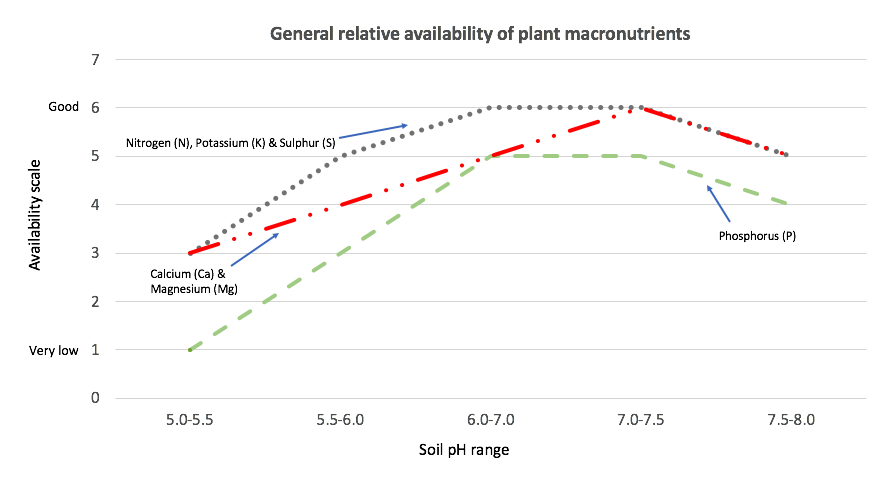
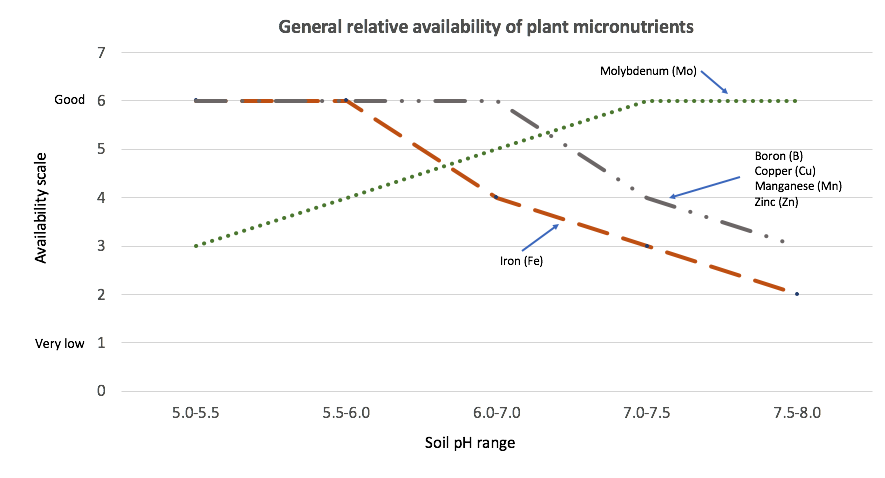
Plant nutrients can be readily available at a suitable rate at certain soil pH values: This does vary for the different nutrients. When the pH is outside of these desirable values then the availability of nutrients becomes less and less readily available as they are effectively locked up by the acidity or alkalinity of the soil.

However, small supplies of many nutrients can still be made available, due to the process of weathering within the soil, even where the soil pH restricts much of the nutrient being released. In some cases, the supplies of nutrients might still be adequate to sustain turfgrasses. Even with higher or lower pH readings, unless there is a demonstrated deficiency, there may still not be a requirement to add additional nutrients to a normal fertiliser programme. This just reinforces the message of making sure your pitch is not just tested for soil available nutrients, but it is also regularly monitored and assessed for surface and rootzone features to provide a more holistic picture of the condition of the pitch.

The following charts provide a general view of the potential availability of nutrients depending on the soil pH and if this might be considered a suitable level of availability for many turfgrasses.

Deficiency could be much more likely in the lowest value of this rating scale (i.e. 1), whilst for those with a rating of 2 or 3 then extractable quantities of nutrients might be limiting grass development.

The actual amount made available to a plant will also primarily depend on the concentration of the nutrient within the soil, as well as micro-organism activity which contribute to making nutrients available.

Please note that this illustrative scale is not related to the Defra Index scale for nutrient management.

Macronutrient availability Micronutrient availability

Considering that the majority of football pitches will be within a pH range of 5.5 to 7.5, the potential availability of nutrients should be sufficient to maintain a desirable playing surface.

However, these types of chart only show potential availability rather than actual availability. For example, the potential availability of potassium might be good at pH 6.5, so that is a good starting place. However, if the concentration of the nutrient is very low, which might occur on a very sandy soil, even with what is available it may still not be enough to help the plant develop strongly.

Carrying out an initial soil analysis to determine the soil pH and available nutrients within the soil is very important to help set the base line for an initial fertiliser programme. This will provide a groundskeeper with a good indication of what they have in their pitch’s soil bank. Only then will they really know what additional nutrients are needed, or not, to maintain a desirable surface in a cost-effective way.

Module progress: 79%