Module 6:

Turf science

6.3 Soil science

6.3.1 Plant nutrition

1 Why is it important to have an understanding of plant nutrition?

Plant nutrition contributes to providing the turfgrass plant with adequate food to ensure that the pitch can withstand a certain amount of wear, helps in its recovery from wear and maintains plant health.

Knowing about the different plant nutrients and the effect they have on grass growth helps a groundskeeper to make better informed decisions in respect of the fertiliser programme they may wish to plan for their pitch.

Getting the fertiliser programme right helps reduce waste and save money on unnecessary fertiliser components and unnecessary applications.

Fertiliser applications contribute in a significant way in getting the most out of your pitch. Incorrect and over applications can reduce the number of games that can be played and can reduce the overall quality of a pitch, so a sensible and cautious approach is the way to go.
2 What is a fertiliser?

This is a material which supplies one or more plant nutrients to help plant development, growth and resilience.

3 What is a plant nutrient?

A chemical element that is essential for plant growth.

There are some 16 chemical elements that are essential for plant, especially grass, growth. These are usually categorised as major and minor elements, using the technical terms of macro-nutrients and micro-nutrients (or trace elements) respectively.

The macro-nutrients are typically used by plants in relatively large quantities, whilst the micro-nutrients are used in relatively small and very minute amounts.

The macro-nutrients are divided into two sub-categories:

  • Primary nutrients of Nitrogen, Phosphorus, and Potassium.
  • Secondary nutrients of Magnesium, Calcium and Sulphur.

There are three macro-nutrients that are not often commented about, these being Oxygen, Hydrogen and Carbon. The reason for this is because of their abundance in the air, soil and water.

The micro-nutrients are: Boron, Chlorine, Copper, Iron, Manganese, Molybdenum, Zinc. These are only needed by turfgrasses in extremely small quantities.

The ratio of N:P:K might typically be 9:1:6, or thereabouts, in the leaf dry matter, and equates to a ratio of N:P2O5:K2O of about 4:1:3 (See W.A. Adams & R.J. Gibbs (1994) ‘Natural Turf for Sport and Amenity: Science and Practice’, CAB International, p60).

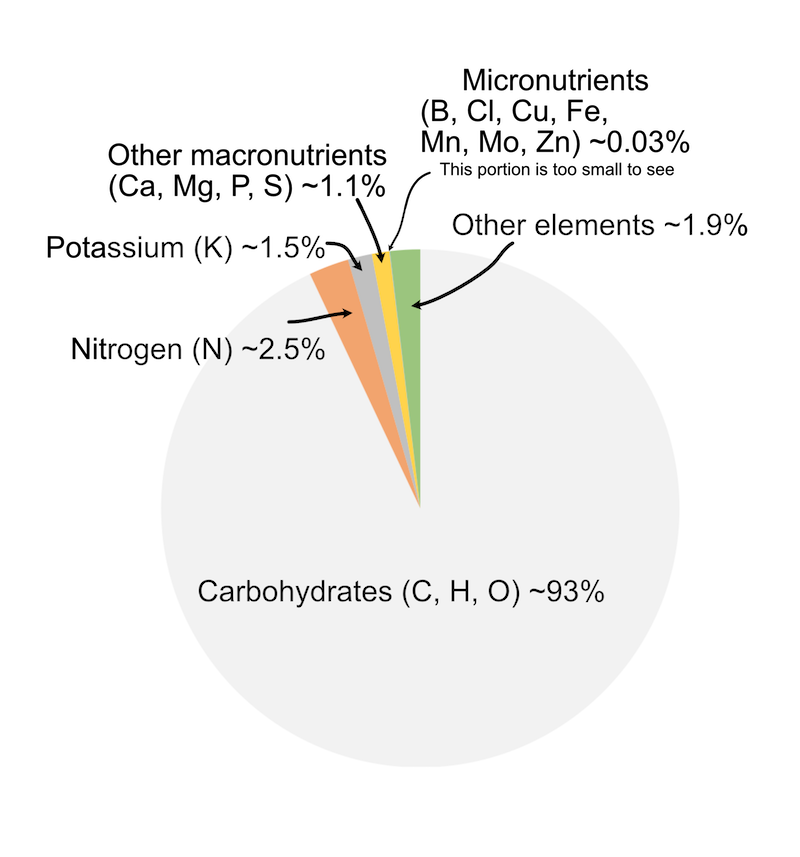
The following diagram also shows an indication of the dry matter composition of a turfgrass leaf for a wide range of plant nutrients. The actual composition from any assessed grass leaf will vary and fluctuate over the year due to a range of factors, including the turfgrass species, cultivar, age of the plant, time of year, closeness to when any fertiliser may have last been applied, etc.

Grass leaf composition of nutrients

Illustration based on Lawson, D.M. (1996) 'Fertilisers for Turf', The Sports Turf Research Institute, p8

Module progress: 62%