Module 6:

Turf science

6.3 Soil science

6.3.1 Plant nutrition

1 What is the most important plant food?

They are all important, although most people will probably say nitrogen as this is applied in the largest quantity to turfgrass surfaces. However, carbon, hydrogen and oxygen are the most important by weight with approximately 90-95% of grass leaf dry matter being composed of these three macro-nutrients.

All of the essential nutrients (macro and micro) are important for plant growth, hence being called essential. None are necessarily more important than others, but rather some have a much more influential and noticeable effect on the growth of a grass plant, with some being needed in much higher quantities than others.

The additional nutrients added by a fertiliser (which can supplement those already present in the soil) can be seen as helping to get the most from the grass plant for the surface being provided, for example, whether a football pitch, fine turf golf green, or similar.

Fertiliser inputs are therefore important due to the wear experienced by sports pitches, the stresses placed on the grass plant by regular maintenance activities and in achieving the desired pitch quality.
2 What factors affect the uptake of nutrients?

There isn’t a single factor that determines how well a nutrient is taken up by a plant, but rather a range of inter-connected factors. These can include the following:

  1. The soil pH. We will look at this in the next section.
  2. The quantity (or concentration) of the available nutrient.
  3. The soil and air temperature, as plants will have optimum temperatures for leaf and root growth. Temperature also influences the drawing up of water from the soil and through the plant.
  4. The soil moisture content. This is essential because nutrients are taken up by roots in watery solution, they don’t eat them like humans.
  5. The overall plant health, so being stressed can reduce nutrient uptake.
  6. Root growth, including root depth, biomass and extent of root spread. More extensive rooting means more area that can be explored for nutrients.
  7. Other nutrients, especially where some are in a high concentration, and the impact they might have on suppressing the availability of some other nutrients.

3 How much fertiliser does my pitch need?

There is a lot to consider here and many variables will influence how much is ultimately needed. We will assume this example is based in the Midlands so as to provide a general indication of environmental conditions.

For a grass roots type soil-based pitch that is looking for say a Grade 2 or 3 quality to be achieve and with grass clippings being let fly and returned so that most nutrients from with the grass leaves will typically recycle back into the soil. The main nutrient input will be nitrogen, with an annual amount generally being the equivalent of 80 -120 kg per hectare.

Most fertiliser programmes will typically be spread over 2 to 4 applications.

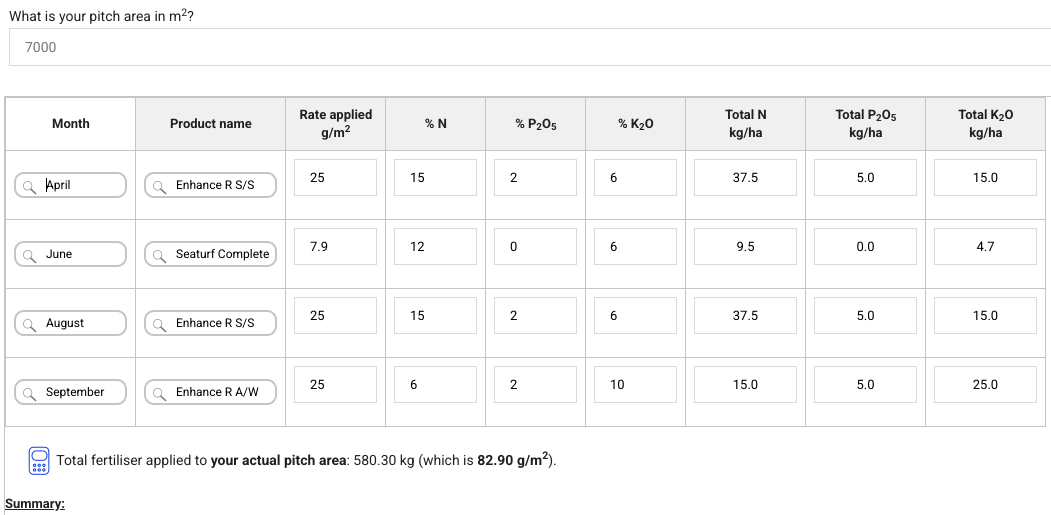
One example is given in the interactive model of a fertiliser programme below, which supplies an annual input of 99.5 kg/N/ha, the following amounts of nitrogen:

  • April: 15%N @ 25g/m2, giving 37.5kg/N/ha.
  • June: 12%N @ 7.9g/m2, giving 9.5kg/N/ha.
  • August: 15%N @ 25g/m2, giving 37.5kg/N/ha.
  • September: 6%N @ 25g/m2, giving 15kg/N/ha.

The more nitrogen that is put on the more leaf growth is made and more mowing is needed to keep the grass to the desired height. Aim for strong steady growth rather than a flush of excessive and unnecessary growth.

There are many variations and adaptations that will better suit a specific pitch due to the many variables that influence decisions for fertiliser requirements that will need to be considered, but the above provides a useful baseline from which to adapt to other needs.

4 Annual Fertiliser Planner

We’ve created this simple model which calculates the nutrient inputs from the total amount of fertiliser applied to a pitch. This is mainly for granular and soluble fertilisers only, with liquid fertilisers having to be converted correctly before being entered into the model.

Fertiliser Model

5 Create your own fertiliser programme

Edit the data in the first 6 columns: Month; Product name; Rate applied g/m2; % N; % P2O5; % K2O; to create your own example.

If you only have, for example, 2 applications of fertiliser then just delete and zero the figures in the rate applied g/m2 column for rows 3 and 4. All the other fields are calculated automatically and cannot be edited. We have used products that were available in 2026 from one provider, Vitax, to illustrate the workings of this programme. ENJOY!

Month Product name Rate applied g/m2 % N % P2O5 % K2O Total N
kg/ha
Total P2O5
kg/ha
Total K2O
kg/ha

Total fertiliser applied to your actual pitch area: 0.00 kg (which is 0.00 g/m2).

* The example for June is a liquid fertiliser, being Seaturf Complete (Vitax Amenity) with an analysis of 12:0:6 on the 10-litre container. The application rate is given as 66-litres of this concentrate per hectare. We have assumed the analysis is on a volume per volume (rather than weight per volume) basis, and have given this a specific gravity of 1.2 as data cannot be found on the relevant data sheets. We have arrived at the rate applied of 7.9g/m2 by the following calculation: 66 litres per hectare = 66,000ml per 10,0000m2 = 6.6ml per m2 x 1.2 specific gravity = 7.9g for 6.6ml (weight per volume) per m2. If this incorrect then the actual values won't be far out from the estimates provided.

6 Summary:

Total nutrient inputs:

Nitrogen (N): 0.00 kg/ha

Phosphate (P2O5) 0.00 kg/ha

Potash (K2O): 0.00 kg/ha

Total of the single element inputs:

Nitrogen (N): 0.00 kg/ha

Phosphorus (P): 0.00 kg/ha

Potassium (K): 0.00 kg/ha

7 Liquid fertilisers

With liquid fertilisers the nutrient content is often given as the volume of nutrient per volume of liquid (v/v). To arrive at the inputs that are usually dealt with in turf management, the specific gravity of the liquid would be needed to convert the nutrient values into a weight per volume (w/v). Many values for specific gravity of liquid fertilisers will be within the range of 1.15 to 1.35, so if this is unknown a value of 1.25 could be used as a general guide. Water has a specific gravity of 1, so obviously the inclusion of other materials within the liquid means that it has a higher density than water alone, hence a higher specific gravity. This is not something we will consider further in this course and will return to using calculations based on granular, or similar, weight per weight (w/w) or weight per volume (w/v) ratios which is the most common for a fertiliser programme.

There is a lot more to fertilisers and plant nutrition than what we have just covered, but for this course we have provided a suitable range and depth of content to provide you with the confidence to understand and utilise them in an effective and efficient way.

Module progress: 75%